One of the clearest consequences of Friday’s violence in Brussels was a bus that could no longer carry passengers. Police confirmed that a STIB bus had been burned, while three other STIB buses and a De Lijn vehicle were damaged, according to BX1’s report with Belga. The destruction brought the argument about public spending down to something tangible: public transport itself.
In an update published at 19:45 on 9 October, BX1 reported a provisional police tally of 80 administrative arrests and around 30 judicial detentions. It said the main march had proceeded calmly, while incidents occurred before, during and after it. Brussels mayor Philippe Close distinguished peaceful participants from a group he said had come to confront police.
A march about wages and household budgets
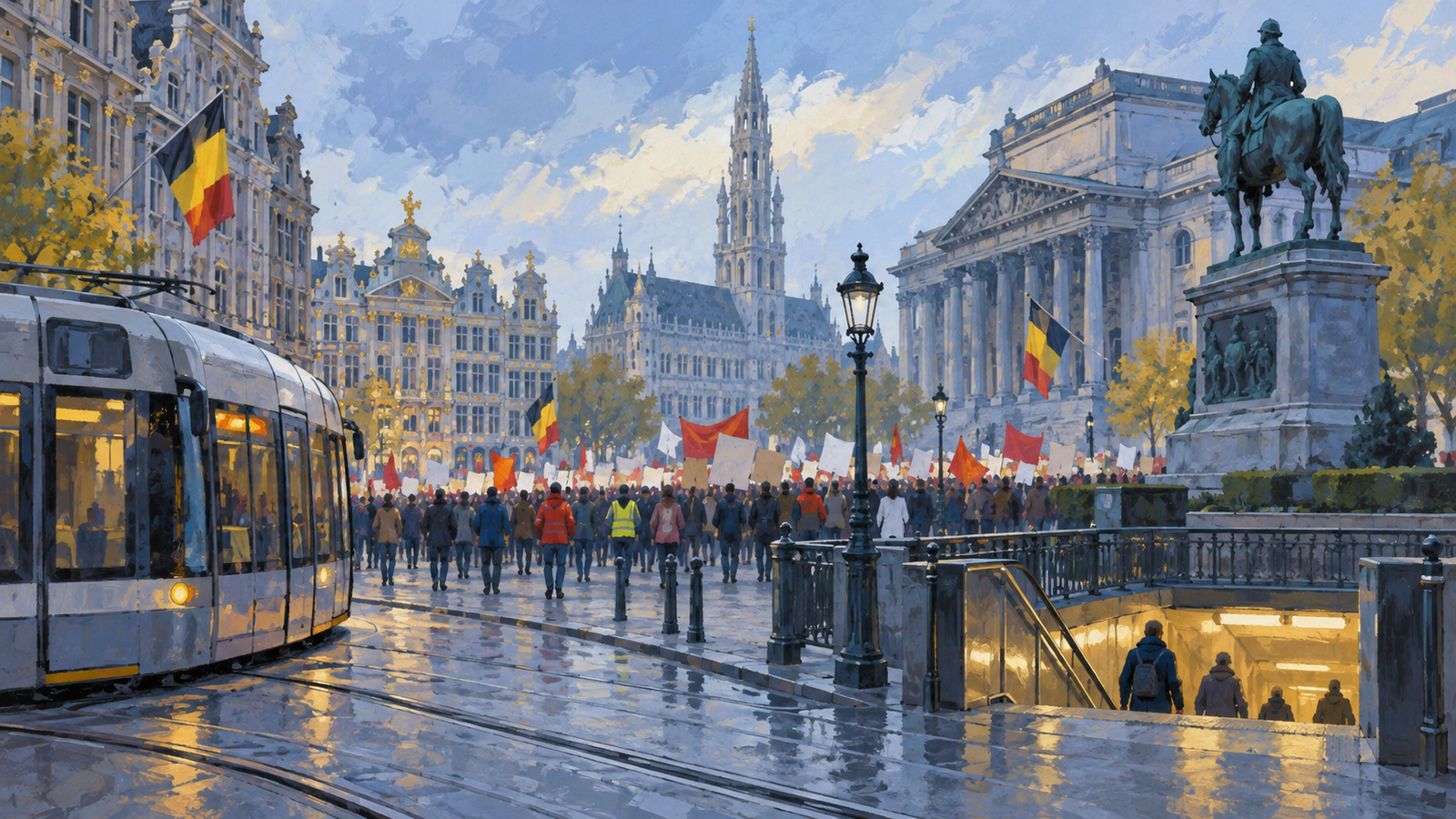
The FGTB Bruxelles organisers put attendance at 50,000. That figure is the union’s estimate, rather than an independently established crowd count. Its account highlighted the participation of young people, students and teachers.
The union’s demands were specific: preserve automatic wage indexation, oppose a VAT increase, and resist imposed flexibility and annualised working hours. It urged the authorities to seek money from large fortunes, capital income and major companies’ profits instead. The FGTB said it would organise a general strike during the week of 23 November if the government crossed those stated red lines. This was a conditional warning, not confirmation that a strike had already begun.
Disorder outside the peaceful procession
Police said groups threw bottles, paving stones, bricks and pyrotechnics at officers; water cannon and tear gas were used. BX1 also reported damaged or burned shared vehicles and damage to emergency-service vehicles. Close called for identified perpetrators to pay for the damage. The police figures remained provisional, and detention does not establish guilt.
Neither the organiser’s account nor the BX1 report establishes an immigration or religious profile for the people responsible. Videos circulating with those descriptions require further verification before the descriptions can be reported as fact.
Analysis: the people left with the bill
Destroying public transport makes a poor answer to an argument about living standards. A bus is useful precisely because people need an affordable way to reach work, school and home. Damage to it creates a repair problem for an operator and a service problem for passengers. The available report does not establish the eventual bill or the extent of any disruption, so those remain questions for the transport companies.
The peaceful march deserves to be understood on its own terms. Wage indexation is a question about purchasing power. Working-time rules are a question about how much control employees retain over their days. A serious account of the dispute should examine the government’s actual proposals and costs, rather than reducing workers’ concerns to images of confrontation.
Equally, those concerns provide no excuse for arson or attacks. There is a straightforward difference between carrying a banner through an agreed route and setting fire to a vehicle. Keeping that difference visible protects peaceful demonstrators as well as the wider public.
The next useful information should be concrete: confirmed damage assessments, charges supported by evidence, and explanations of the budget measures under dispute. If officials seek compensation from offenders, the legal process and the amount recovered should be made clear. Residents should be able to see what happened after the promise of a firm response.
There is also a reason to be careful with the videos. A broken windscreen can be documented. The religion or legal status of the person who broke it cannot be read from the glass, or established by a caption underneath a repost. Where evidence identifies a perpetrator and a relevant background, it should be reported accurately. Where that evidence is absent, filling the gap with an assumption only weakens the story.
For now, Brussels has a documented episode of serious destruction around a largely peaceful labour demonstration. The task is to follow the damage, the investigations and the policy dispute without letting any one of them erase the others.
Reporting note: this article draws on BX1 / Belga and the organisers’ published statement. People’s Reporter’s did not attend the march or interview participants.

Independent reporting. A European perspective.